
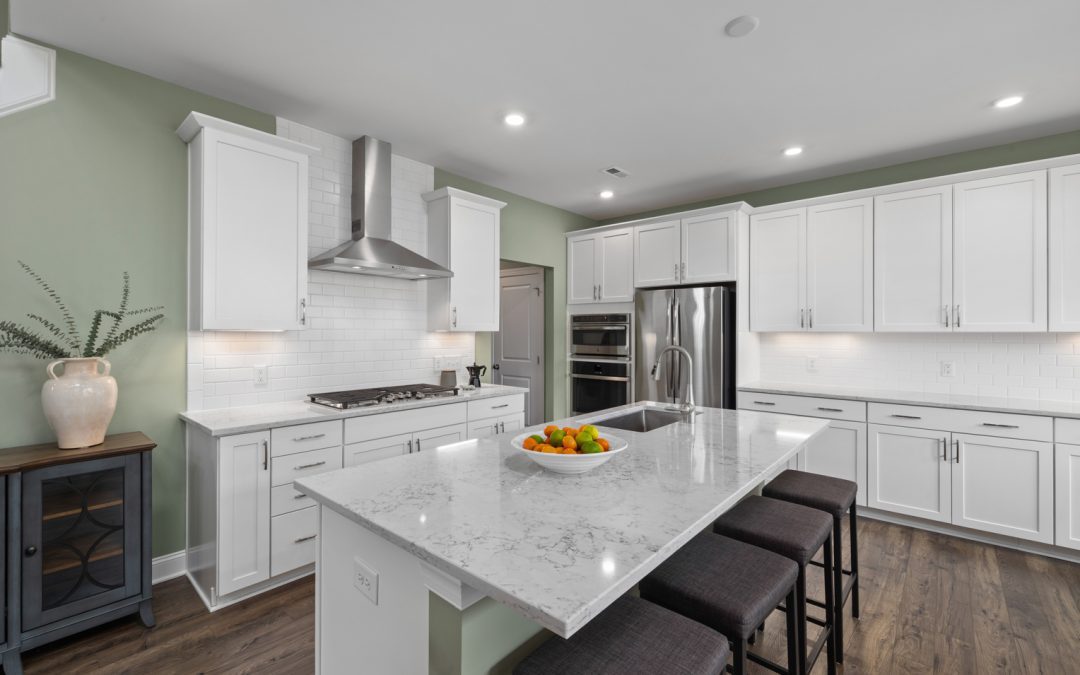
Almost nobody walks in with a budget that covers everything on the mood board. That is not a failure of planning. That is just what kitchens cost.
So the real question is never whether to compromise. It is where. And after forty-odd years of building and renovating kitchens, we can tell you that some compromises you will have forgotten about by Christmas, and others will quietly annoy you every morning for 15 years.
Here is how to tell them apart.
The rule worth remembering
Save on the things you can change later. Spend on the things you can’t.
That is the whole framework. A handle takes ten minutes and a screwdriver. A cabinet carcass takes a demolition crew. Anything you can swap out on a Saturday is a fair place to save money, and anything that would mean pulling the kitchen apart is where your budget earns its keep. Apply that honestly, and the hard decisions mostly make themselves.
Four places you can save without regret
- Handles. They are the jewellery of a kitchen, but they are also the single easiest thing to upgrade later. If the budget is tight, fit something simple and tidy now and put the brass ones on your list for when the credit card has recovered. A beautiful set of cabinet handles makes an enormous visual difference, which is exactly why it is satisfying to change later rather than treating it as a tragedy to defer.
- The splashback. This one sits in front of the cabinetry, not inside it, so it can be replaced without touching anything structural. A simple tiled or glass splashback now does not stop you from fitting the one you actually wanted in five years. It is also usually measured after the benchtop goes in; you can delay the decision and the spend.
- Appliances. Nobody will ever know what you paid for your oven. Buy in the sales, or keep the dishwasher that is working perfectly well and replace it when it gives up. The one thing worth deciding early rather than cheaply is this choice: integrated or freestanding. That affects the surrounding cabinetry and can’t be changed on a whim.
- The benchtop material. This surprises people, but laminate is not what it was 20 years ago. Modern laminate and thermolaminated ranges carry convincing stone structures and woodgrains. In a kitchen with good cabinetry underneath, they look considerably better than their price suggests. Stone is lovely. However, it is also the item that most often pushes a kitchen budget past the breaking point, plus there are benchtop options at every level in between.
Four places where saving comes back to you
- The box behind the door. Everything you own sits on the carcass. The board it is made from, its thickness, whether it is moisture-resistant where it needs to be, and whether the exposed edges are properly sealed. You will never see any of it, and it is the difference between a kitchen remodel that is still square in 20 years and one that swells under the sink in three. This is the honest gap between custom cabinetry and a flat-pack kitchen, and it is the last thing we would ever cut.
- Drawer runners and hinges. You will open these somewhere north of 50,000 times. Good hardware is the difference between a drawer that glides shut when loaded with cast iron and one that sags, catches and eventually needs the whole front re-hung. If you are fitting deep drawers for pots and pans, the weight rating matters more than almost anything else in the quote, which is why we work with Blum rather than whatever happens to be cheapest that week.
- The design itself. Time spent getting the kitchen layout right is the cheapest money in the entire project, because it costs almost nothing and fixes everything. A bin in the wrong place, a fridge door that blocks the walkway, a cooktop with nowhere to put a hot pan down. None of these is expensive problems to solve on paper. However, all of them are expensive to fix later.
- Anything inside the wall. While the kitchen is out, the walls and floor are as open as they will ever be. Adding a circuit, moving a waste pipe or putting a power point where you will actually want one is comparatively easy right now and genuinely painful later. These are the classic costs people wish they had absorbed the first time.
You don’t have to spend evenly.
Here is the part that gets lost in most advice on this subject. Nobody is asking you to buy the top specification of everything, and a kitchen built that way isn’t automatically better. It is just a more expensive one.
Mixing levels is normal, and we do it constantly. Excellent carcasses with a laminate benchtop. Premium hardware behind modest doors and panels. A plain splashback above a thoughtfully planned layout. Those kitchens work beautifully, and they age well, because the money went into the parts that carry the load.
What doesn’t work is the reverse: a showpiece benchtop sitting on cabinetry that won’t hold it properly. We would rather talk you out of that than build it.
Can you do it in stages?
Sometimes, and it is worth asking. The trick is to design the whole thing now and build it in parts, rather than designing twice.
If you know a walk-in pantry or a run of cabinetry along the far wall is eventually coming, we can plan the services and the sizing for it from the start, then leave it off this invoice. The joinery that arrives in two years then lands in a space that was expecting it, instead of being wedged in afterwards.
What does not stage well is the cabinetry run itself. Matching a finish or a hardware system years later is harder than people expect, and colour batches move. If the main run is going in, it is worth going in together.
Where to start
If you are weighing this up right now, start with the two decisions that are hardest to undo, which are the layout and the cabinetry. Get those settled. Everything in front of them can flex to fit what is left.
Krauss Kitchens has been designing and manufacturing in Unanderra since 1974, and part of what a designer does in the first conversation is help you work out where your money will do the most good. A free in-home consultation is usually the point where a vague kitchen renovation budget turns into a plan. It also helps to have a rough sense of what a kitchen costs around the Illawarra before you start, so the conversation can begin somewhere realistic.
Whatever you decide, decide it on purpose. A kitchen you chose carefully on a modest budget will beat an expensive one you drifted into every single time.
This article is general guidance about prioritising a kitchen renovation budget. Material and hardware choices depend on your layout, site and how you use the space. Costs vary with scope and selections.