
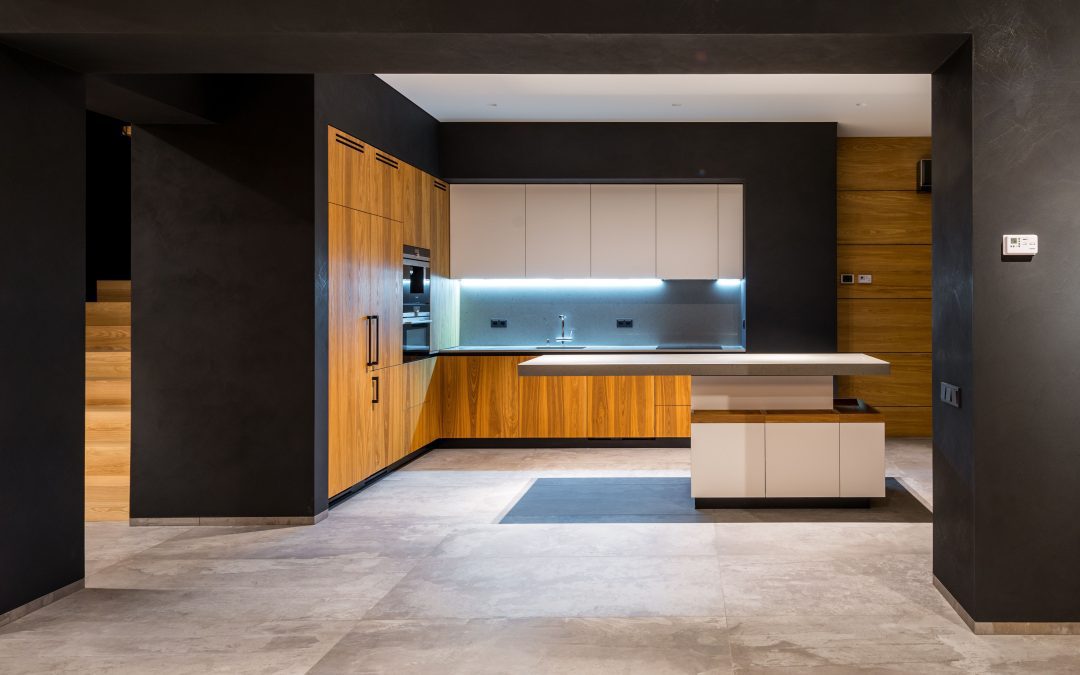
There’s nothing quite like the visual drama of a cantilevered kitchen island. When walking into a home and seeing a massive, gorgeous piece of stone or wood seemingly floating in mid-air with zero visible support legs, it takes your breath away. It instantly elevates a space from standard to sophisticated, transforming a basic preparation zone into an architectural statement piece.
Beyond looking incredible, a cantilevered island is highly functional. By omitting traditional support posts or bulky cabinet bases beneath the overhang, a kitchen gains precious legroom and a seamless, airy vibe that makes even compact layouts feel twice as big.
But a vital question always arises during the design phase: Is it actually safe?
The short answer is yes—but only when you (or, at least, your kitchen contractor) know how to support a cantilever beam correctly. A heavy slab of porcelain, sintered stone, or natural quartzite cannot simply be thrown over a cabinet edge with the hope for the best. To pull off this look safely, the physics of a cantilever installation and the hidden framing required to make it structurally sound must be properly executed.
The Rule of Thumb: The 2/3 to 1/3 Ratio
Before diving into steel plates or brackets, the conversation must start with basic balance. The fundamental law of any cantilever is the rule of thirds.
To keep a floating bench stable, at least two-thirds (2/3) of the total weight and depth of the countertop slab must be firmly anchored down to the base cabinetry. That leaves a maximum of one-third (1/3) of the slab to extend out into the room as the floating overhang.
Attempting to stretch that overhang any further without major structural reinforcement turns the island into a giant see-saw. The moment someone leans heavily on the edge, the entire structure could tilt, or the stone itself could snap under the stress.
The Secret Weapon: Hidden Steel Supports
Because modern design favours sleek profiles and thin, minimalist stone edges, relying on chunky, old-school wooden corbels to hold up the weight is rarely an option. Instead, the strength must be hidden inside the cabinetry itself.
The gold standard for a clean cantilever installation involves heavy-duty steel support plates or flat steel brackets.
During the framing phase, the top edges of the island cabinets are mortised (notched out) so that solid steel plates—usually a quarter-inch to a half-inch thick—sit perfectly flush with the wood. These plates extend far back into the island structure, where they are secured with heavy-duty fasteners directly to the framing. They then reach out under the stone overhang, stopping just a few inches short of the edge so they remain completely invisible to anyone standing or sitting nearby.
For exceptionally deep or long floating sections, a fully welded steel sub-frame is often built to bolt directly to the subfloor through the bottom of the island cabinets. This effectively anchors the entire island to the foundation of the house, ensuring that absolutely nothing budges.
The Hidden Counterweight: Anchoring the Base
While reinforcing the overhang is crucial, it is only half the battle of a safe cantilever installation. Equal attention must be paid to what is happening under the unexposed side of the island. If the base cabinetry isn’t securely anchored to the floor, the weight of a heavy stone overhang acts as a lever, threatening to lift the back of the island right off the ground.
To prevent this tipping hazard, the island’s base cabinets require heavy-duty internal structural framing. Instead of relying on standard cabinet screws, the internal framework is reinforced using heavy-gauge L-brackets bolted directly through the cabinet floors and deep into the home’s subfloor structure, as mentioned above.
In kitchens with concrete slab foundations, masonry anchors tie the cabinetry down permanently. If the floor is framed with timber joists, the island must be positioned so that the primary fasteners bite into solid wood joists, or structural blocking must be added between the joists from below. By turning the entire island base into an immovable, rock-solid counterweight, the floating edge remains perfectly stable no matter how much real-world use it sees.
Tailoring the Support to Your Material
Different materials behave differently when suspended in mid-air, meaning the choice of benchtop dictates the exact support strategy.
- Natural Stone & Premium Mineral Surfaces: Slabs like granite, marble, quartzite, or ultra-durable porcelain are incredibly beautiful but can be surprisingly brittle when subjected to bending forces. They have zero flex. If a stone or large-format porcelain overhang is pushed too far without rigid steel plates underneath, it will fracture.
- Solid Timber & Butcher Block: Wood handles tension better than stone and can often extend slightly further without cracking, but it’s prone to warping or bowing over time due to humidity changes. If you’re going for timber, structural support is as much about keeping the wood perfectly flat as it is about keeping it up.
- Polished Concrete: A heavy-hitting material that brings a beautiful industrial edge. Concrete is cast with internal rebar or carbon-fibre mesh reinforcing, but because of its sheer weight, the underlying cabinetry and steel supports must be heavily reinforced to handle the massive downward load.
Clear Up the Confusion: Cantilever vs. Waterfall Benchtops
When exploring high-end kitchen layouts, it is incredibly common to hear the terms “cantilevered island” and “waterfall benchtop” thrown around in the same conversation. While both styles deliver an undeniably premium, architectural look, they are completely different design concepts.
The difference comes down to where the countertop meets the floor:
- A waterfall benchtop is defined by continuity. The stone or timber doesn’t stop at the edge of the cabinet; instead, it makes a sharp 90-degree turn and flows vertically all the way down to the floor. It acts as a beautiful visual end-cap for the island structure.
- A cantilevered island, on the other hand, is all about suspension. It deliberately leaves the space beneath the stone open and empty. No vertical panels or posts are returning to the floor on the outer edge, creating that striking, gravity-defying float.
Can these styles be combined? Absolutely. A truly show-stopping modern layout features a countertop that cantilevers out for seating, and then drops into a beautiful vertical stone panel at the very end.
If the continuous, flowing look of stone sides sounds like the perfect fit for your home, dive deeper into the aesthetics, costs, and material choices in the comprehensive guide to waterfall benchtop kitchen design.
Getting the Details Right
Dreaming of a floating feature in a new kitchen project or kitchen remodel requires getting an experienced team involved early. The structural engineering must be planned before the cabinets are built and long before the stone fabricator arrives to measure.
When done right, a cantilevered island isn’t just a design choice—it also becomes the functional heartbeat of the home, offering an easy-to-clean footprint and an inviting spot for family and friends to gather.
Ready to bring this striking feature to life? Connect with Krauss Kitchens to craft a stunning, architecturally sound space. We have years of experience building custom kitchens, and we’re capable of getting the details right.