
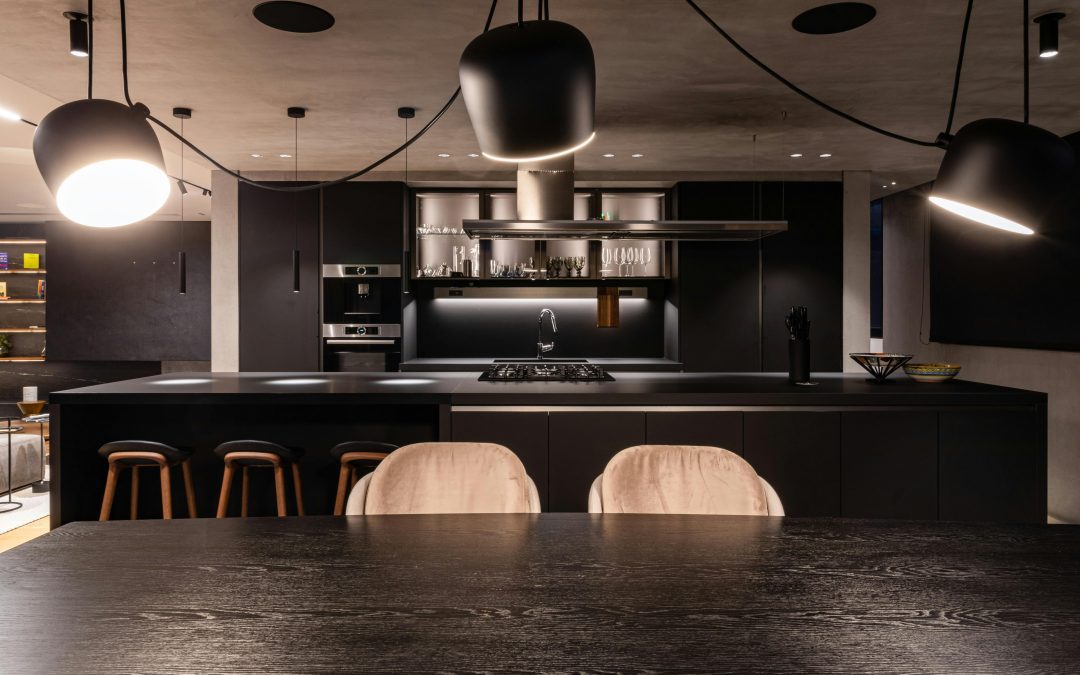
There’s a moment when you step into a kitchen, and something just feels off.
The cabinets look good. The splashback has depth. Even the finishes feel premium. But the space itself? It feels heavy, like it’s not breathing properly.
Most people assume it’s the colour, but that isn’t always the case.
More often than not, it’s actually the lighting.
Dark kitchens can look way better than lighter ones, yes, that’s true—but only when the lighting in the kitchen is planned properly.
Without that, even a well-designed space starts to feel closed in. And this is usually where things go wrong.
Lighting gets treated as a final step. Something you “add” once everything else is done. But in reality, it completely changes how the entire space functions once everything is in place.
Why Dark Kitchens Need More Thoughtful Lighting
Matte cabinetry, darker stone, even deeper-toned splashbacks—they don’t bounce light around the same way lighter materials do. So when everything relies on a single overhead source, you start getting uneven patches. Bright in one area. Shadowed in another.
That’s where the “heavy” feeling comes from.
A lot of people try to fix it by adding a stronger light. But that usually just makes the contrast worse.
What actually works is layering.
Instead of relying on one source, you spread light across the space. Different levels. Different angles. Each one is doing a specific job.
Kitchen specialists, like our team at Krauss Kitchens, take this into account early in the design process, treating lighting as part of the overall layout rather than something added later.
What “Lighting in Layers” Actually Means
Layered lighting sounds technical, but it’s fairly straightforward.
You’re combining three main types of lighting:
- Ambient lighting – the general light across the room
- Task lighting – focused light where work happens
- Accent lighting – subtle highlights that add depth to your space
Together, they create a more balanced environment.
Layering different light sources improves both visibility and efficiency in a space. For a dark kitchen, this approach is almost essential. Without it, surfaces tend to blend together. Details get lost, and worse, the space feels flatter than intended.
Layering separates those elements again. It gives the kitchen dimension.
Start with Ambient Lighting
This is your base.
Ambient lighting sets the overall tone of the kitchen. It’s what you rely on when you first walk in. Ceiling lights, downlights, and sometimes even larger feature fixtures. But here’s where people miscalculate. They focus on how bright the light is, not where it lands.
In darker kitchens, spacing matters more than intensity. Even distribution helps avoid shadows forming in areas that are already visually heavy.
If you’re wondering how much lighting in kitchen spaces is actually needed, the answer depends less on wattage and more on placement.
A well-spaced layout often performs better than a single strong source.
Add Task Lighting Where It Counts
This is where functionality comes in.
Task lighting is what you use when you’re actually working— prepping, cooking, cleaning. And in dark kitchens, this layer does most of the heavy lifting.
Under-cabinet lighting is one of the most effective solutions. It directs light exactly where it’s needed, especially along benchtops and splashbacks. It also helps separate the cabinetry visually, keeping everything from blending into one darker block. You’ll often see it paired with reflective or textured splashbacks, which help distribute light more effectively across the surface.
Use Accent Lighting to Add Depth
This is the layer people skip.
And it’s usually the one that makes the biggest difference visually.
Accent lighting isn’t about function. It’s about the atmosphere. Soft lighting inside cabinets. Subtle strips along shelving. Even lighting is integrated into handles or trims.
It breaks up flat surfaces.
It adds contrast without making the space feel harsh.
Accessories also play a role here. Integrated lighting solutions, internal fittings, and even cabinet features can support how light moves through the kitchen.
When done right, accent lighting just improves everything around it.
Choosing the Right Light Temperature
This part is often overlooked. Cool lighting can make dark kitchens feel sterile. Warm lighting can make them feel too dim if not balanced properly.
Somewhere in between usually works best.
Neutral tones help maintain clarity while still keeping the space comfortable. Especially when paired with darker finishes.
Realistic Ways to Make a Dark Kitchen Look Lighter
You don’t always need to change the cabinets.
Sometimes, it’s about adjusting how the space is lit.
A few practical approaches:
- Add under-cabinet lighting to brighten work areas.
- Use reflective splashbacks to distribute light.
- Layer overhead lighting instead of relying on one fixture.
- Introduce subtle accent lighting to break up darker sections.
These are small changes, but they make a noticeable difference.
If you want to see how these ideas come together in real spaces, visiting a showroom helps. Explore our kitchen setups and lighting integration.
At the end of the day, decisions are easier when you can actually see how they behave in a finished space.
Planning Lighting Early Makes Everything Easier
Lighting is often treated as a final step.
But in reality, it works better when it’s planned alongside the kitchen design itself.
Placement. Wiring. Cabinet structure. Even material choices—all of these affect how lighting performs.
When those decisions are made together, the result feels intentional. Not added on later.
If you’re planning a new kitchen or updating an existing one, working with a team that considers lighting from the beginning can save time and adjustments later. You can speak with the Krauss Kitchens team to explore options that suit your layout.