
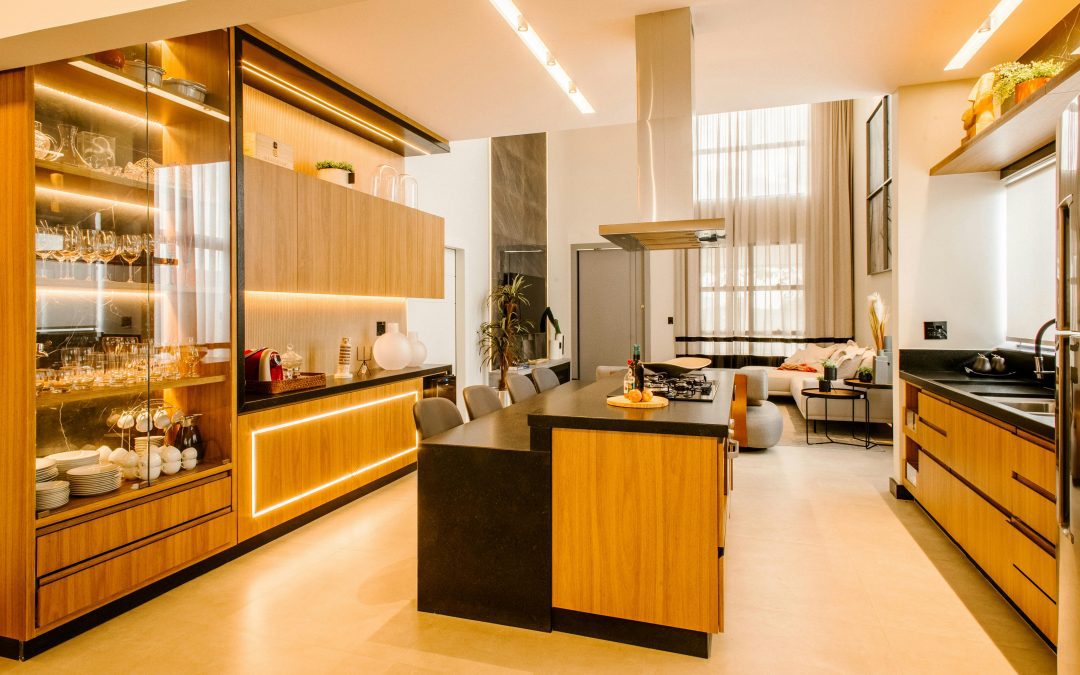
Most of us fell in love with the idea of open-plan living long before we had to live with the reality of a roaring range hood. We imagined seamless transitions and airy aesthetics, but we didn’t necessarily sign up for the sound of a range hood or blender competing with our favourite TV show. As we lean further into open-living kitchen floor plans, we’re realising that while we’ve mastered the art of how a kitchen looks, we sometimes forget how it sounds. Let’s talk about the power of acoustic engineering and quiet cooking to keep your home peaceful without putting up a single wall.
The Science of “Soft” vs. “Hard”
Most kitchens are a playground for echoes. Think about the materials we love: quartz, tile, hardwood, and stainless steel. These are “hard” surfaces, and sound waves bounce off them like a rubber ball in a hallway. When designing custom kitchens, the goal is to disrupt those reverberation patterns.
To reduce noise in an open-plan house, try to introduce “softness” in clever, stylish ways. This doesn’t mean you need to carpet your kitchen (please, don’t do that). Instead, look at things like acoustic backing on the underside of your breakfast bar or choosing integrated cabinetry that breaks up flat, echoing surfaces. Even something as simple as high-quality, heavy-duty window treatments or upholstered bar stools can act as a “sound sponge,” soaking up the clatter of plates before it travels into the lounge.
The Secret Power of Silent Appliances
If you’re serious about creating a quiet cooking experience, your first line of defence can be your appliance list. In the old days, you knew the dishwasher was working because it sounded like a small jet engine taking off. Today, whisper-quiet technology is the gold standard.
When planning a new kitchen, look for appliances with decibel ratings lower than a library whisper. But the real culprit in an open space is usually the ventilation. A standard builder-grade fan can ruin a dinner party conversation in seconds. If possible, invest in a high-quality, quiet kitchen hood or a specialised quiet kitchen exhaust fan that utilises external motors. By moving the actual motor part of the fan into the roof cavity or outside the wall, you get all the suction with none of the roar.
Zoning for Peace
Design plays a massive role in reducing noise in an open-floor plan. It’s all about the work triangle, but with an acoustic twist.
In kitchen renovations, think about where the noisy zones are—like the sink and prep area—and try to angle them away from the primary seating in the living area. Strategic placement of a pantry or a scullery nook can also act as a physical buffer. If possible, tuck the noisy dishwasher and the espresso machine into a semi-enclosed butler’s pantry. By doing that, you’ve effectively silenced the two loudest members of the kitchen family.
It’s All in the Hardware
You might not think about your hinges as part of acoustic engineering, but they are the unsung heroes of a peaceful home. There is nothing that shatters a quiet morning quite like a cabinet door slamming shut.
Whether renovating or building a new kitchen, consider soft-close hardware. It’s not just about luxury; it’s about removing the “sharp” sounds from your environment. Also, look at the thickness of your cabinetry. Solid, well-built carcasses vibrate less than thin, flat-packed versions, which means your kitchen stays hushed even when the mixer is at full tilt.
Don’t Forget the “Clank” Factor
We spend a lot of time talking about motors, but what about the sound of a fork hitting the bottom of a sink? In an open-plan kitchen, that sound can ring out like a bell.
Consider undermount sinks with heavy-duty rubber dampening pads or specialised acoustic coatings. It sounds technical, but the result is simple: instead of a high-pitched ping when you drop a spoon, you get a dull, satisfying thud. The same goes for stone selection. Thicker slabs (think 30mm over 20mm) or mitred edges don’t just look more substantial; they have more mass, which helps naturally reduce noise in an open-plan house by absorbing vibrations rather than amplifying them.
Why Acoustic Design Matters for You
An open-plan kitchen design for the living-dining areas is supposed to bring people together, not drive them into separate rooms with noise-cancelling headphones. By thinking about acoustics during the design phase, you can ensure that you can sear a steak and chat with your guests at the same time without having to shout over the extractor fan.
Let Us Help You Design a “Silent” Kitchen
At Krauss Kitchens, we’re here to do the heavy lifting—and the quiet thinking—so you don’t have to. We’ll help you navigate the decibel levels and the material choices to ensure your kitchen is as serene as it is stunning. Get in touch with us today. Let’s discuss your kitchen project.